Rethinking Group Assessment under the influence of AI
Reflections from the “AI in Group Assessment” Session at the 2026 eAssessment Association Conference.

At a recent eAA conference session, titled “AI in Group Assessment,” the room crackled with a different kind of energy you only get when people realise a long‑standing problem might finally have a new set of tools. Or to sound less AI, it was a fun session that got a great response…
In this session, James Spurgeon (RM) and I, kindly introduced by Matt Wingfield (eAA board member), explored a deceptively simple question:
If AI-driven analysis of group interactions became trustworthy, what new kinds of assessment could we design—and what old assumptions would we have to let go?
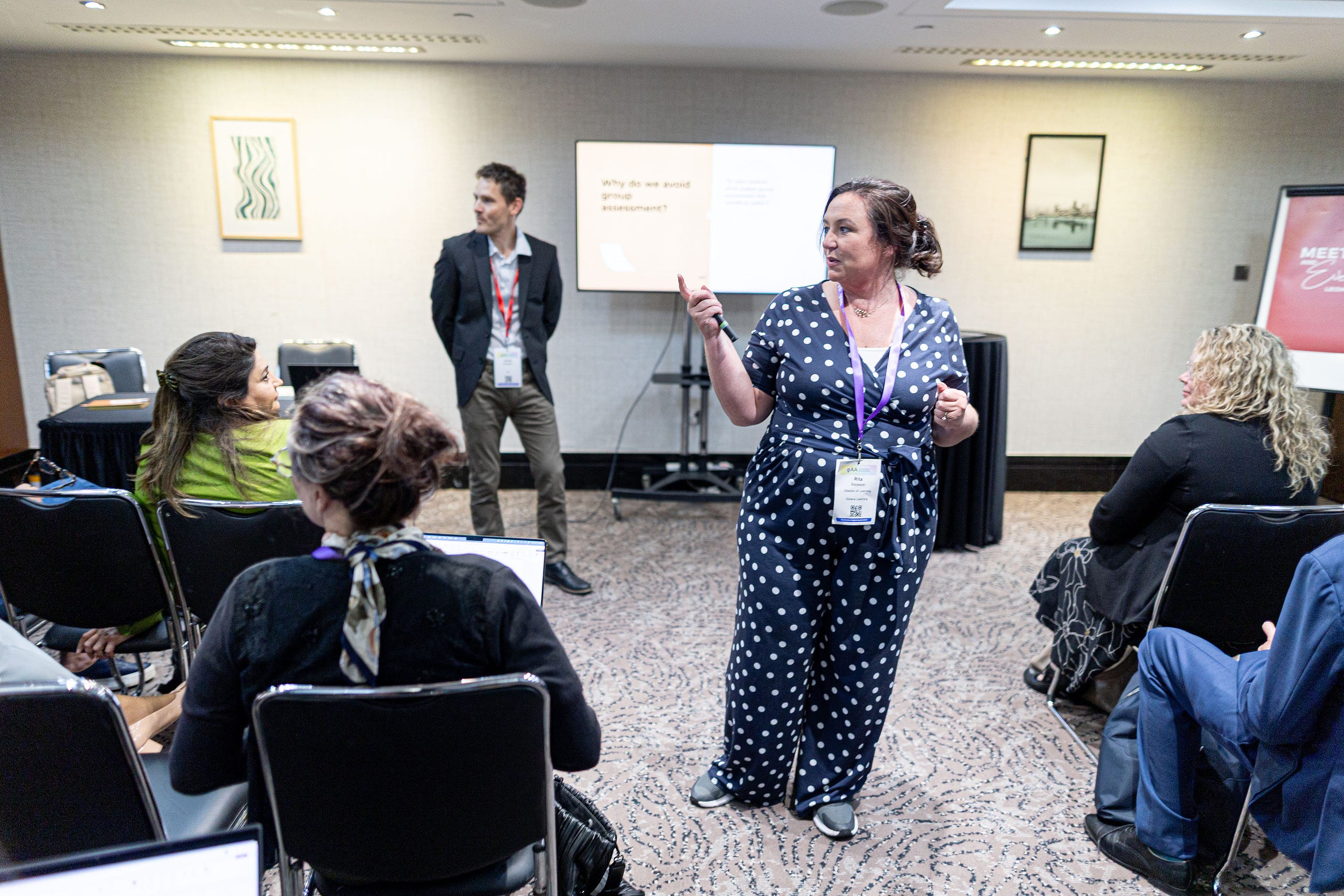
I described the motivation for this session came from my experience in Assessment conferences over the last two years - an unshakeable feeling that most AI work in assessment was focused on efficiency and protection (cheating, malpractice) rather than new forms of evidence or new questions we could ask.
I wondered … “Where are the weirdos?? Where are the people who are working on the edges of the possible and unexpected, the absolute unlocks of AI?
I realised I had to be the weirdo…. and so the idea for this session was born.
This session attempted simply a start on this work. Our intention was a deliberate attempt to push at the edges of what counts as assessable, fair and meaningful when humans work together. Scientists or doctors rarely operate in isolation, marketing or teaching teams seldom work alone. So, why aren’t we assessing and training learners for that?
Why Group Assessment Still Feels “Interesting but Dodgy”
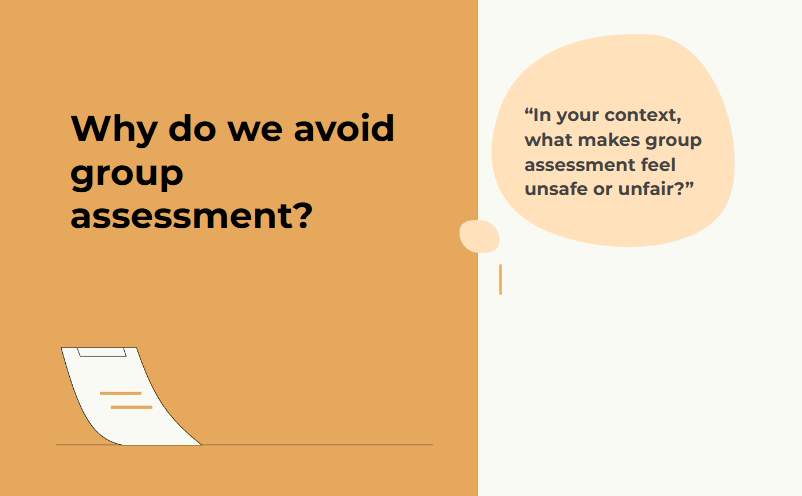
The session opened with a provocation:
Given the long history of assessment, why is group assessment still seen as invalid, unfair, or unsafe?
Participants immediately surfaced familiar pain points:
Fairness & freeloaders – As one participant noted, quieter students often don’t get recognised, while dominant contributors can overshadow them, yet “they’re all getting the same grade.”
The workplace reality check – A business school academic reminded the group that: “Group work is impossible to ignore when you get into work environments… it is also unfair, and it is also about collaboration, and the quieter ones still need to sort of shine… I don’t think we can avoid it, but that doesn’t necessarily mean it’s easy.”
The assessment mismatch – Another participant captured a systemic tension:
“We focus a lot on the assessment and the summative piece… our systems are based on an end result or a mark, and those two things don’t correlate often.”
Our starting premise was that group work is everywhere in life and almost nowhere in credible high‑stakes assessment, this was the starting point.
Platforms, Policy and the Invisible Handbrakes
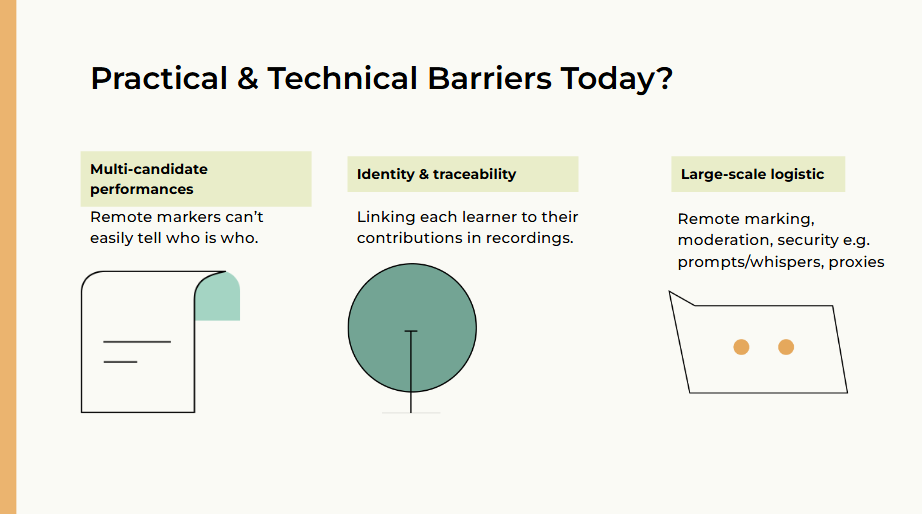
Before diving into AI applications to this problem, James helped the group unpack some of the non-technical blockers:
1. Digital platforms designed for individuals
James highlighted that most digital assessment platforms are still architected around the individual candidate:
“Most assessment platforms have been developed from the concept of individual test exam on screen test type marking scenarios. Are they best suited to assessing a group dynamic and individual performances within that group?”
He pointed to very practical questions:
When watching a recording of four candidates, how does an assessor know who is Candidate A?
Should assessors score all candidates together to get a sense of group dynamic, rather than slicing them into isolated marking views?
Can current systems faithfully transmit subtle interpersonal dynamics from live performance into recorded evidence?
2. Policy as a structural blocker
One participant traced how policy can abruptly shut down innovation:
He described an early 2000s project - a collaborative e-portfolio that “vacuumed up” audio, video, and text to support individual assessment around group projects. He reported systemic inertia, i.e. it “never went anywhere” after policy changes under Michael Gove pushed systems back toward high-stakes, academic knowledge testing and away from coursework and collaboration.
What could we consider next?
In the last couple of years, I have been playing with AI tools in spaces where it feels safe to experiment: my own meetings and conversations, recorded with genuine consent and clear expectations.
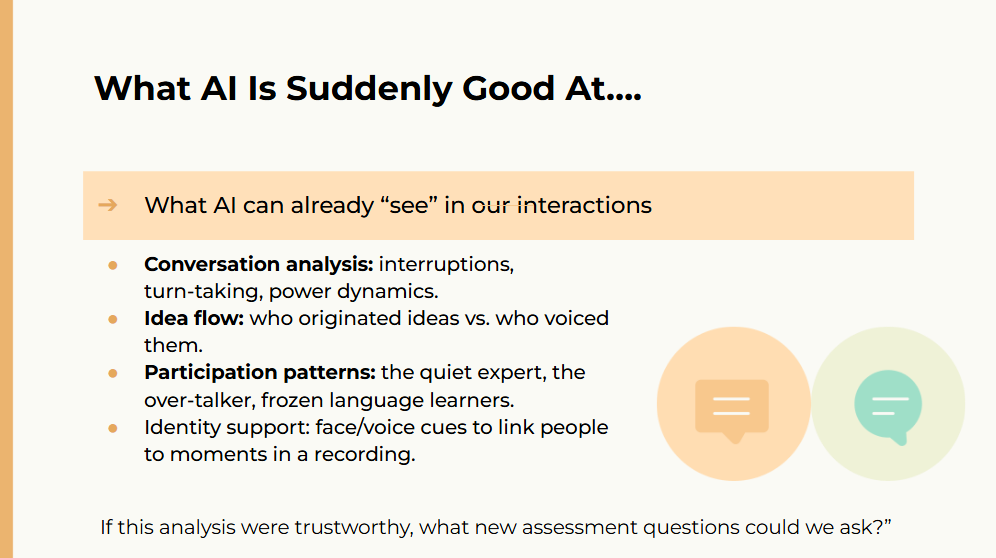
If AI can detect sentiment, power dynamics, interruptions, idea flow, and participation patterns in a teacher’s meeting, couldn’t it also do that in a student group assessment?
Using transcription and conversational AI, I started asking questions such as:
- Who is driving the agenda?
- Who is holding institutional power compared to subject-matter authority?
- Who originates ideas, and who develops them?
- Where do ideas begin to surface but then get cut off or taken over?
- How balanced is the participation?
- What are the emotional patterns across the conversation?
The answers were, frankly, unnerving in their accuracy. In one meeting with a publisher, for example, AI did a surprisingly good job of distinguishing between my role as content expert and my counterpart’s institutional decision-making power. It identified the rhythm of our contributions, mapped out where ideas were co-constructed, and described the relational tone in ways that largely aligned with my own sense of the meeting.
Another powerful example came from a group of teachers at one of our Eblana Learning Partner Schools. They deliberately staged, and recorded, a classroom scenario where one person dominated and behaved poorly toward another, mimicking the dynamics they sometimes see in student groups. When they fed this into AI for analysis, the system was able to separate the genuinely valuable contributions from the performative dominance and identify who was effectively bullying and controlling others. It recognised substance over volume.
These are not controlled psychometric studies. They are small, imperfect experiments. But they suggest that AI can already detect, at least to a workable degree, patterns of interruption, dominance, contribution, power, and collaboration that were previously invisible or too labour-intensive to track.
Taken together, these experiments suggest that AI may already be able to:
Detect problematic group dynamics (domination, interruption, erasure, marginalisation, bullying)
Rate the quality of collaboration, giving a high score and citing examples
Track who interrupts whom and how often
Identify dominant vs. quieter contributors
Surface micro-moments where an idea begins to form but is cut off or taken over
Attribute idea origin and co-construction (“who started this idea, who developed it?”) more fairly, especially for quieter or less confident participants:
Infer roles in a conversation (agenda-setter, explainer, challenger, supporter)
I never thought in my entire educational career that Group Assessment might be back on the table in this way and I am quite excited by the possibility that we should start experimenting with these notions, if even just as a proof of concept.
We are still a long way from a fully worked-out model of AI-enabled group assessment, and we should be. It requires careful design, research, and policy work. But we are no longer at the stage where it is purely hypothetical. The tools already exist to begin experimenting safely and responsibly at the edges. It might finally allow us to see the richness of human interaction in ways that make fairer, more meaningful group assessment possible.
If this kind of thinking or experimentation interests you, please do get in touch!
Thanks to RM Assessment for the invitation and platform to speak to a very different type of topic and to James for his incredible collaboration - I think AI would rate our group assessment very highly indeed! Thanks too to Grainne Watson for her interesting perspective on this topic too.
AI Disclosure: I used AI to summarise the session and thoughts but was highly frustrated by all the “It’s not about this, it’s about THIS” that I wrote most of the article instead.